In 2023, some companies are still deploying their infrastructure on physical equipment in local data centers, purchasing boxed software licenses, and building their own application development platforms. All of this requires significant financial, human, and time resources.
With cloud services, the situation is reversed. For them to work stably, all you need is a stable internet connection and a reliable service provider who will take care of maintenance and technical support for the solutions.
In this article ,ITGLOBAL.COM experts describe the types of services available, their advantages, who they are suitable for, and how to get started with them.
The history of cloud technologies
Until the 1960s, computers were large, expensive, and could only be operated by one specialist. This led to the idea of shared infrastructure, but it was not implemented until the 2000s. The first SaaS solutions and CRM systems appeared during the same period.
In 2006, Amazon, which was then engaged in online book sales, created the Elastic Cloud service, which became the prototype for the modern IaaS model — “Infrastructure as a Service.” In 2008, ITGLOBAL.COM became a VMware service provider in Russia, making the company the first cloud provider in the country and giving a powerful boost to the development of cloud technologies and services.
What are clouds and cloud services?
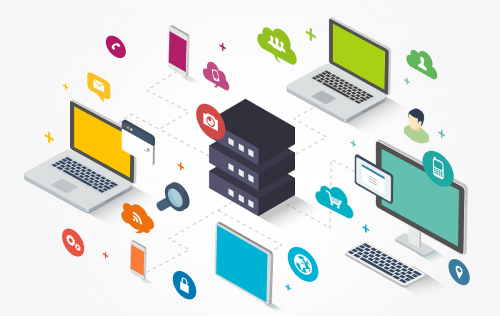
Clouds are a network of powerful servers that allow users to work with resources via the Internet: analyze big data, store confidential information, deploy virtual desktops, work simultaneously with several teams on one project, and perform calculations.
Cloud services are essentially online programs or other tools that help organize remote work and solve various business tasks. They have replaced classic “boxed” offline programs that need to be installed on individual computers.
A cloud network consists of information storage and processing nodes called data centers. They are located around the world and connected via the Internet. Cloud providers build and maintain them independently or work with partner data centers, distribute the resources of physical servers to separate VMs, and lease them out.
For example, ITGLOBAL.COM’s partner data centers are located in seven countries around the world: two in Russia and one each in Belarus, Kazakhstan, the Netherlands, the United States, Canada, and Turkey. In 2023, the provider plans to expand the geographical presence of its cloud platforms to the United Arab Emirates, Hong Kong, Mexico, and Brazil.
Types of clouds
There are four types of clouds:
- Public cloud. A cloud provider rents computing resources to businesses, which are shared among the service provider’s many customers. A public cloud can be quickly deployed and scaled, making it suitable for development and testing environments or as a backup site.
- Private cloud. A computing environment used by one specific company. The cloud infrastructure is isolated from other customers of the cloud provider, making it suitable for hosting critical services and confidential information. Any customized solutions can be implemented in a private cloud.
- Hybrid cloud. Some services are hosted in a public cloud, while others are hosted in a private cloud or on physical servers in the customer’s local data center. Businesses often use hybrid clouds when gradually transitioning from traditional infrastructure to cloud infrastructure.
- Multi-cloud. Businesses use solutions from several cloud providers to work with the most advanced technologies, get the best conditions on the market, quickly scale resources, and minimize the risk of failure of critical applications.
Types of cloud services
Depending on their needs and goals, businesses can choose the following cloud services:
- IaaS (Infrastructure as a Service). The customer rents computing power in the provider’s public cloud and pays for resources on a pay-as-you-go basis, i.e., only for the amount actually used.
- PaaS (Platform as a Service). Customers get access to a ready-made platform for developers. With it, they can create mobile and web applications and specialized software for business. PaaS speeds up the development, testing, and delivery of applications.
- SaaS (Software as a Service). The cloud provider gives customers customized programs in the cloud to solve different business problems. For example, CRM, ERP, ITSM systems, task trackers, and other software.
In addition to the basic IaaS, PaaS, and SaaS services, there are several other solutions:
- BaaS (backup as a service). The customer receives a service for creating backups. In the event of equipment failure, the company will be able to restore its data and continue working as usual.
- DRaaS (disaster recovery as a service). Replication of the client’s servers to the cloud provider’s servers, which allows the company’s infrastructure and all data to be restored in the event of a local data center failure.
Advantages of cloud services
Compared to deployment on physical equipment in a local data center, cloud solutions offer the following advantages:
- Reliability and security. If a cloud provider places its equipment in data centers that have all three Tier III certificates from the Uptime Institute, the risk of accidents is minimized, and security standards and processes comply with international standards.
- Transition from CAPEX to OPEX. Businesses do not need to take money out of circulation and invest it in the purchase of expensive equipment and software. The customer only needs to pay a monthly subscription fee or pay for resources on a Pay-As-You-Go model.
- Technical support from the provider. The service provider is responsible for administering cloud services. This allows businesses to save on hiring and maintaining IT staff and focus on developing their own products and services.
- Flexibility and scalability. Cloud providers have a lot of computing resources, so businesses can increase their capacity when necessary, for example, during sales periods, and then simply abandon them afterwards.
Disadvantages of cloud solutions
Despite the advantages of cloud services, they do have some drawbacks.
- The need for a stable internet connection. To use cloud services, you need a stable and fast internet connection, otherwise your business will not be able to access data and applications.
- Risk of data leakage. Customer data security will be compromised if the cloud provider deploys customer clouds based on questionable data centers that are not Tier-certified and do not use additional information security measures.
- Dependence on the service provider. The stable operation of cloud services depends on the cloud provider that provides these services to the customer. For example, data center failures can lead to downtime, financial losses, and reputational risks.
Cloud service security
Cloud services are actively developing, but many companies still do not trust them and prefer to work on-premise. Below are four facts that speak to the security of cloud solutions:
- Tier certification and global standards. If cloud services are deployed in a Tier III-certified data center, it means that it is designed, built, and operated in accordance with global standards, including security standards.
- High-end equipment without a single point of failure. High-end equipment is manufactured by global market leaders such as Cisco, Dell EMC, Hewlett-Packard, and NetApp. Equipment nodes are duplicated, so the failure of one or more components does not affect its operation.
- Additional features and information security measures. ITGLOBAL.COM uses monitoring and analytics systems to detect internal and external threats and offers its customers additional information security measures (ISM).
- Technical support from the provider. Enterprise providers usually provide their customers with round-the-clock technical support. For example, in case of questions or malfunctions, ITGLOBAL.COM customers can contact technical specialists by phone, email, or through the self-service portal to quickly resolve the issue.
The use of cloud technologies in business
Cloud services can be useful for virtually any company or business, regardless of their size or field of activity. For example, startups use PaaS to quickly develop, test, and launch their applications and services without having to invest in expensive infrastructure.
Medium and large businesses use SaaS, i.e., ready-made software in the cloud, and delegate service administration to the service provider to reduce staffing costs. Large corporations achieve high performance and availability with IaaS to consistently work with multiple users, large amounts of data, and heavyweight services.
Due to disruptions in supply chains, longer delivery times, and the cost of physical equipment, Russian companies will increasingly migrate to the cloud and use cloud services in the coming years.
How cloud services will develop
Cloud services are a rapidly growing industry, and they will continue to develop in the future. According to MarketsandMarkets forecasts, the cloud services market will grow by 17.5% per year until 2027. This can be explained by the fact that more and more companies and organizations are switching to cloud services in search of flexible and efficient infrastructure.
One of the key trends for the future development of cloud services is the widespread use of artificial intelligence and machine learning. Cloud services will work with these technologies to create intuitive and automated solutions that will help companies perform their tasks faster and more efficiently.
Another area of development for cloud services will be the use of the Internet of Things (IoT) and smart devices. Cloud services will provide the infrastructure for processing and analyzing data received from smart devices. This will help companies make faster and more accurate decisions based on data from multiple sources.
In the future, new models for providing cloud services may emerge, such as blockchain cloud services, which will provide decentralized data storage and exchange. This may be of particular interest to companies that work with confidential data.
How to get started with cloud services
Getting started with cloud services is easy if you follow these simple steps:
- make sure that the cloud service is suitable for your specific business task;
- Conduct an audit of business processes, analyze technical requirements, determine the budget, and assess risks and potential problems.
- Ensure the reliability of your network and Internet connection, as this directly affects the quality and speed of the services. You also need to develop a data backup strategy and a recovery plan in case of failure or security breach.
- protect your data, for example, by encrypting information or using secure communication channels;
- choose a cloud service provider, make sure it is reliable and has a good reputation in the market, and carefully read the SLA and contract. We have providedmore details on choosing a service provider in a separate article.
 Previous article